"The moment you doubt whether you can fly, you cease forever to be able to do it." – "Peter Pan" (J. M. Barrie)
"My curiosity is stronger than fatigue," asserts Morena at the end of the day.
It is a day of strong emotions.
This morning we wake up to a different world. The Đồng Văn Karst Plateau, this piece of land between China and the rest of Vietnam in the extreme north, is indeed a kind of alien. There are 17 ethnic groups living together on a tiny 2,300 km², but the largest of them are the Black H'mong (H'mong Đen), a people whose superpowers we are still to discover later that day.
This land of dry, rocky limestone mountains, rising steeply like icebergs from the sea, is an isolated area where living conditions are harsher than anywhere else in the country. It is also a sudden shift from rice to corn. Curious how just one plant, one crop, can bring us from one planet to another.
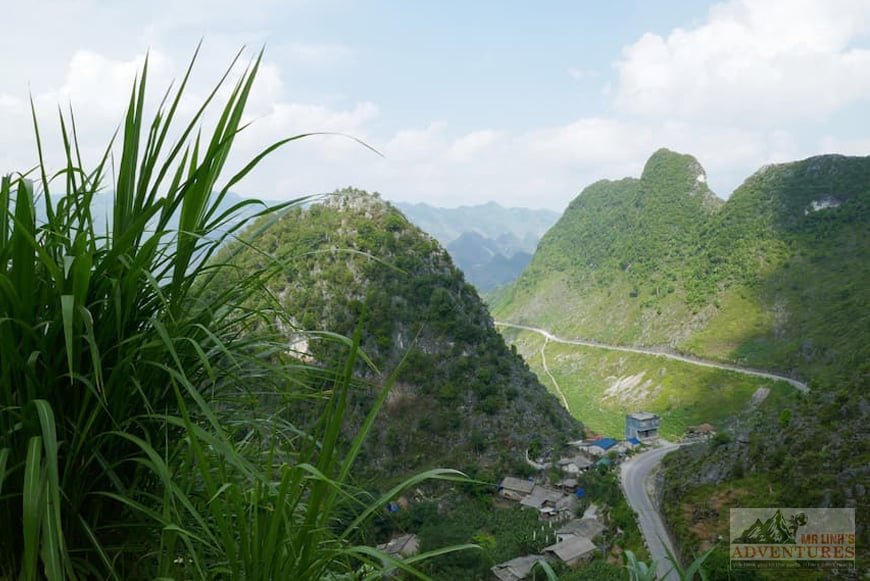 Stunning view from the Dong Van Plateau | Mr Linh's Adventures
Our day snakes up and down these astonishing mountain roads. No wonder we are not the only ones. This strange and different H'mong world attracts thousands of young people in search of beauty and adrenaline. So when we stop for photos, we join them. For a moment, we are no longer the only privileged overseas travellers welcomed as exceptional guests. At those panoramic viewpoints, we become part of the crowd. Every young person rushing carelessly through this country finds it fashionable to look ethnic, without even knowing whose tradition it is, by buying exactly the same brightly coloured ethnic-style headscarf. Do those young men even know that this is traditionally a female head covering?
I don't like being a tourist. In my opinion, not every traveller is a tourist. But those who take the world for granted, yes. Do those foreign men ever question whether walking around shirtless in public places is any less impolite in Vietnam than at Saint Peter's Square in the Vatican or at the Loire Valley castles in France? And do they see the local people with whom they bargain as their equals?
I am also sad for those H'mong who have decided - or been pushed by circumstances - to earn their living dressed in traditional clothes, a basket on their back, spending the whole day waiting for some adrenaline-seeking tourist to take a picture with them and the colourful scarf. What will remain of themselves and their culture after months and years of doing that?
"People here are not smiling. They look sad," many keen observers in my Italian group remark.
"Indeed. H'mong people generally tend to keep to themselves and mix little with others," David explains.
But I wonder whether the isolation of this karst plateau, enclosed by impossible mountains, does not play a part in this seriousness and introversion. This region used to be autonomous. And until recently there was no proper road. So how many foreigners did they actually see? David says that thirty years ago many people here knew nothing about Hanoi, and nothing even about Hà Giang, only 150 kilometres away.
Or perhaps poverty, slightly more visible here, plays its part? Or perhaps the recent history, with the border region being closer to conflict?
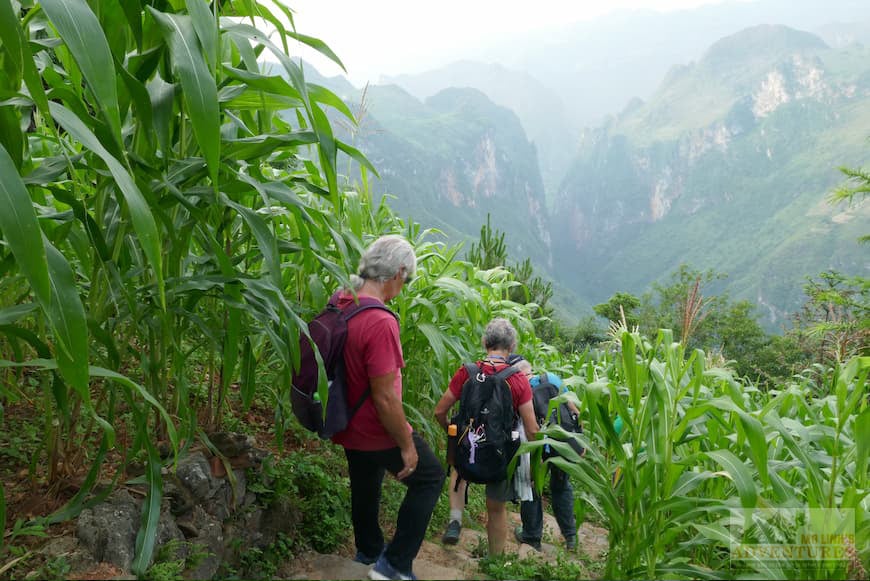 Few of us dared to go to Heaven | Mr Linh's Adventures
I also wonder what traces the forced cultivation and consumption of opium have left in the collective memory and subconscious of this people.
We reach Sà Phìn to visit the second H'mong King's Palace, this time a magnificent Chinese-style building, around 120 years old, standing on a hill said to resemble a turtle's back. This man, Vương Chính Đức, could he have been even a little bit of a good person, a good king, if he made his people grow and consume opium with the help of the French colonizers, simply to grow rich? And still, the numerous old black-and-white family photographs on the walls somehow make it all more real, more intimate, and give the palace a human face. The ancestors' altar inspires respect.
And then it happens. We bear witness to the impossible.
This morning I was frustrated. Deeply frustrated. As our group has a demanding journey behind it, with lots of walking and intense heat, they asked for an easier day. So instead of 8 km, David reduces our afternoon walk to 4. And as I hear from a third party that those 8 km would have been one of the most beautiful walks of our journey, I learn a great deal about myself: I am the world's worst accepter of inevitability, of circumstances imposed on me. How hard it is for me to let go when I know that something crazy exciting lies within touching distance. How hard it is to accept not seeing a potential miracle for reasons that have nothing to do with me. We only live today! That is my eternal urge: to live life to the fullest.
But our super-guide David suddenly finds a solution for everyone. We split into two groups: the exhausted ones stop after 4 kilometres, while the others go to Heaven.
Yes, it is literally Heaven, as the path is called the "Sky Path".
Already at the start, we come face to face with miraculous human capacity: Con đường Hạnh Phúc - the Happiness Road. A 175-kilometre road that, thanks to the determination of Ho Chi Minh, began to bring the Black H'mong and sixteen other ethnic groups out of isolation, connecting people who had rarely encountered those living even 200 kilometres away. All the people who worked on this road project in the late 1950s and early 1960s were volunteers. Almost all of them were very young. They used little more than simple tools. They defied the winding heights of the plateau. They worked for six years without Sundays, as many Vietnamese still do today. Some of them never returned home.
And the result is stunning, even viewed from a bus window. But we, the brave ones, continue through these landscapes with our own two legs as our only engine.
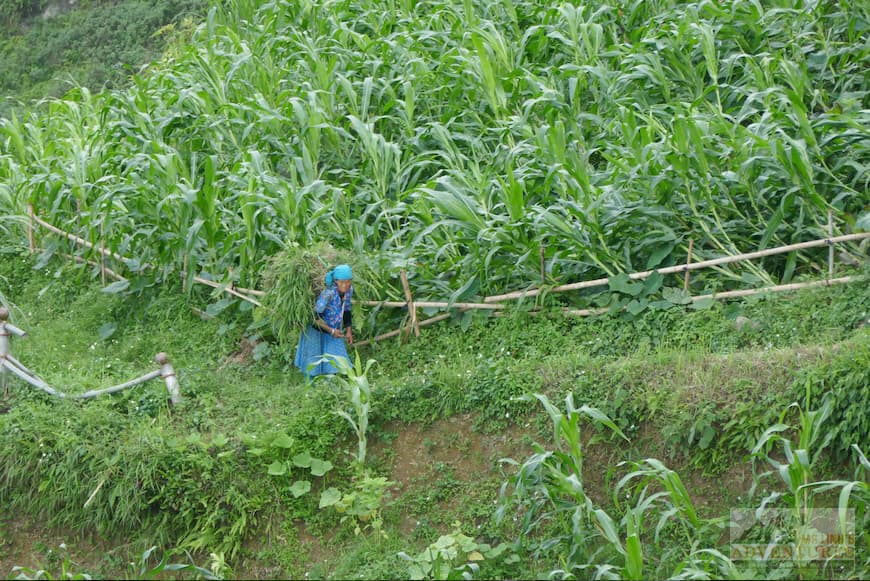 Here, corn fields are like walls | Mr Linh's Adventures
And there the superpowers reveal themselves.
There are no rice fields. But neither are there corn fields. Because one can hardly call "fields" those rocks descending almost vertically down the mountainsides. And yet those naked limestone cliffs are full of corn.
"H'mong people brought soil here, you know," David explains. "They put it into the little holes in the rock and plant corn there."
I look at those huge corn plants on slopes that could almost be called walls... and I simply cannot get over it. Who is the crazy creature capable of climbing up and down here? It's just not human!
Well, those are the Black H'mong - the serious, introverted people with no smile. "Even the five- or six-year-old children can do it," confirms David. They must be incredibly fit, climbing up and down these mountains every single day. I well understand why people here need a good bowl of noodle and beef soup for breakfast and not jam and bread.
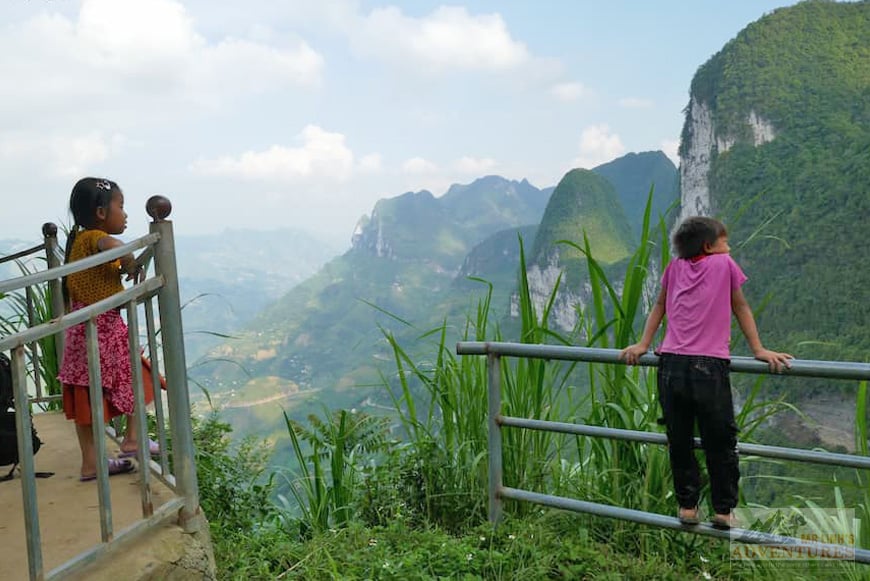 The Hmong: a life of resilience | Mr Linh's Adventures
And then, in the next chapter of the adventure book, we, the smaller half of the group, lose our breath. We can barely walk. So eager are we to take photographs every few seconds. With our cameras, but also with our eyes, our souls and our bodies.
The path grows narrow. It winds upward, zigzags down and climbs again, clinging to the cliff face. Three steps and stop. One step and stop. Just to give ourselves time to believe the unbelievable. One wrong step to the left and we would find ourselves a few hundred metres lower. And on those vertical slopes, a few Black H'mong are working. What a surprise it would be for them - an European flying down from above!
They know nothing about gravity, therefore it does not exist.
Two young girls emerge from the ravine, guiding the goats for which they are responsible. They carry out their duties with complete seriousness. Time to go home. One by one they gather the goats. The younger girl walks ahead, the older follows with a huge bundle of hay on her back. They look at us indifferently. No smile offered, no hostility either. They are simply carrying out their responsibilities.
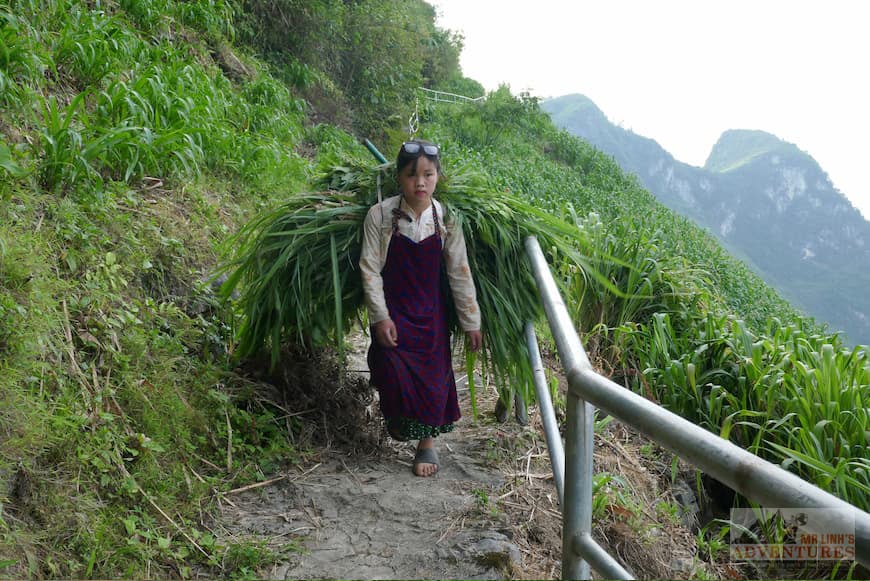 Young hard working | Mr Linh's Adventures
Until the mountain leads us down again through tiny Black H'mong villages that mind their own business. We are outsiders. No smile nor beckoning hand invites us in. And I find that cool too. It is not rude. It is simply their life we are crossing, so let us try to be respectful.
After the solitary walk to Heaven, the tourist mecca of Mèo Vạc, full of homestays, welcomes us. With kind inhabitants. But also with karaoke, gathering people who, diplomatically speaking, are not my favourite singers.
"It wasn't easy, but I wouldn't have missed it for the world," says Morena.
Text & Photos © Ena Mets - June 2026