The hidden door
The language barrier isn't a wall. It's more like one of those
secret doors you find in old castles. Not the grand entrance with all the explanatory plaques, but the small trapdoor covered in cobwebs. The one used by people who'd rather not get distracted by official speeches. You push it open when words make too much noise and let through what actually matters.
That morning there were six of us at the foot of a mountain in
Ba Bể National Park, where the limestone hills of Northeast Vietnam dip their green fingers into the dark waters of the country's largest natural lake. The trail, narrow and stubbornly winding, coiled between terraced rice fields like a ribbon with too much dignity to lie flat. The sky had just wiped its eyes with a light downpour, turning the ochre earth into mud as tenacious as it was unsuited for walking.
Thanh, our guide for this
3-day trek with Mr Linh's Adventures, stopped dead. With the quiet authority of someone who knows both the rocks and tourists unaccustomed to jungle hiking, he raised his hand, palm down - that universal gesture meaning "wait," "don't move," and sometimes "if you insist, you'll be the one counting ants while we pass." He speaks English, obviously (all
Mr Linh's guides are required to), but he knows what anyone who's learned that language has holes knows: when fatigue sets in, words take unannounced vacations. So he put his index finger to his lips. Silence. The kind that isn't empty but contains a plan.
The problem is, silence like a badly punctuated sentence, invites multiple readings.
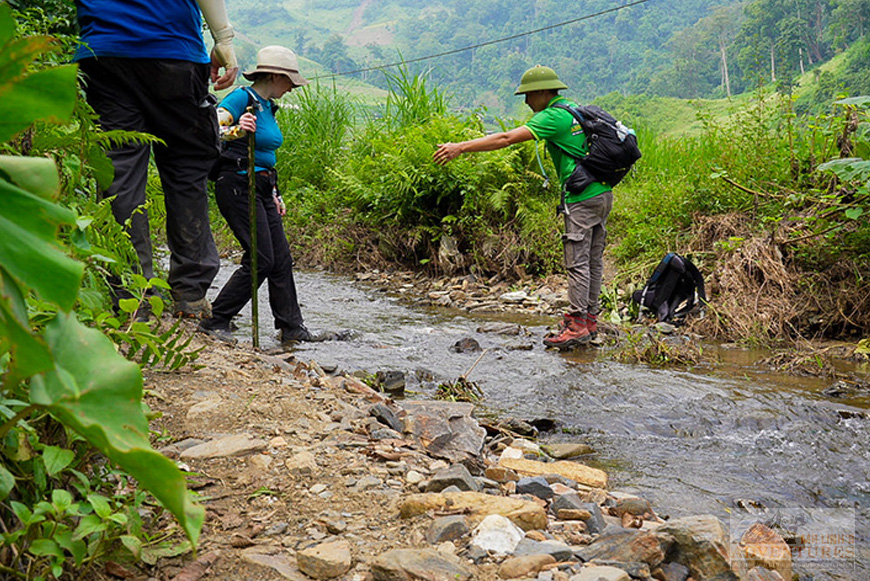 Following someone whose language and codes you don't share can still become a quiet promise | Mr Linh's Adventures
The mime festival
Thanh attempted an explanation in English, offering three words as concise as road signs: "Rock... slip... danger." Simple, neat, clear. At least to me. But the French couple we'd met in Cao Bang - including newlyweds from Marseille on a belated honeymoon - heard "snake" and started backing away as if the ground had turned into a game board rigged with sneaky serpents. Carlos, the Spaniard from Barcelona, pulled out his phone to translate, crushing in the process a wild orchid Thanh had probably wanted to show us. As for me, driven by solidarity panic and linguistic ingenuity, I decided to translate "slippery rock" into Spanish.
I don't speak Spanish. This was a detail I should have kept warm in my memory, but apparently, I'd lent it to someone else.
So I mimed some hybrid between mudslide, contemporary dance routine, and simulated cardiac arrest, all while shouting: "¡Piedra! ¡Muy... uh... dancing?" Carlos looked at Thanh. Thanh looked at me. Then, as if asking the sky for its opinion on the choreography, he shrugged. The sky, busy preparing the next shower, politely declined the invitation.
So Thanh did something only guides, actors, and cats know how to do: he slipped, caught himself on a bamboo stalk that may have existed solely for this moment, and let out a small, perfectly calibrated universal "Oops!" Silence fell for a second, then Carlos burst out laughing ; a Spanish laugh, full of joy and conviction. The French followed. Me, I was trying to figure out where on earth my brain had pulled that improbable translation from.
We were six strangers incapable of putting words to what we were saying to each other, yet perfectly capable of laughing at a Vietnamese man miming a fall. It was absurd, therefore necessary. It was perfect, therefore true.
The trek had just begun: in this world, gesture and laughter form the only two dictionaries you really need to cross countries, and sometimes lives.
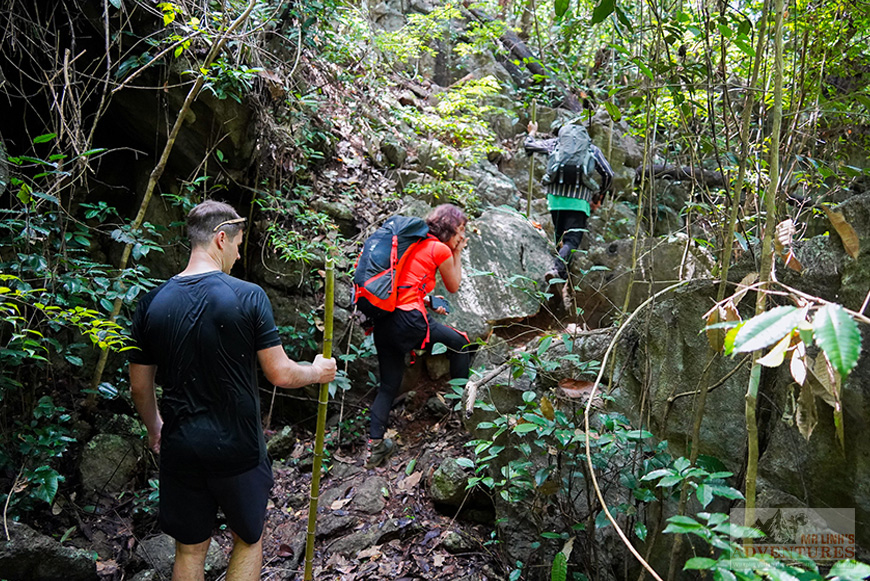 "I trust you, walk ahead" | Mr Linh's Adventures
Learning to read the interface
By day two, I started to understand. It wasn't telepathy. It was fine observation, made possible because Thanh had stopped talking.
I learned to see his shoulders tense imperceptibly before unstable ground. No "careful, it's slippery", just micro-rigidity in his upper back. To notice his breath stopping when he sensed an animal nearby, freezing us all without a gesture. To decode his slightly quickening step when a viewpoint approached, that physical anticipation replacing "we're almost there."
He taught us an alphabet where every gesture means: watch out, step here, stand straight, wait. By learning to read his body, we involuntarily learned to read the mountain itself.
And that's where the lesson lies: learning a language, sometimes, isn't learning other words but learning other ways of inhabiting the world. Thanh gave us the most useful dictionary there is : a tactile, discreet, highly practical survival guide. And he didn't even want a paper copy.
The gradual detox
Thinking back to write this, I realize the first hours had been destabilizing. I'd realized how much my cognitive comfort depended on continuous commentary; that need to name, contextualize, validate through language. Without Thanh's explanations, I felt, using a word too grand for it, stripped. A bit as if the experience had lost substance because it hadn't been stamped and sealed with words.
Then came the mime festival, that human comedy where we were all bad actors and no one felt humiliated. Shared ridiculousness had defused anxiety.
Psychologists call this "restorative attention." A term that sounds like something out of a psychiatry student's textbook and basically means you finally stop grinding your mental gears. For me, it was mostly a detox from running commentary. For three days, no one told me what I was supposed to feel. No one handed out emotional instruction manuals. My only brief: be here. And I just felt.
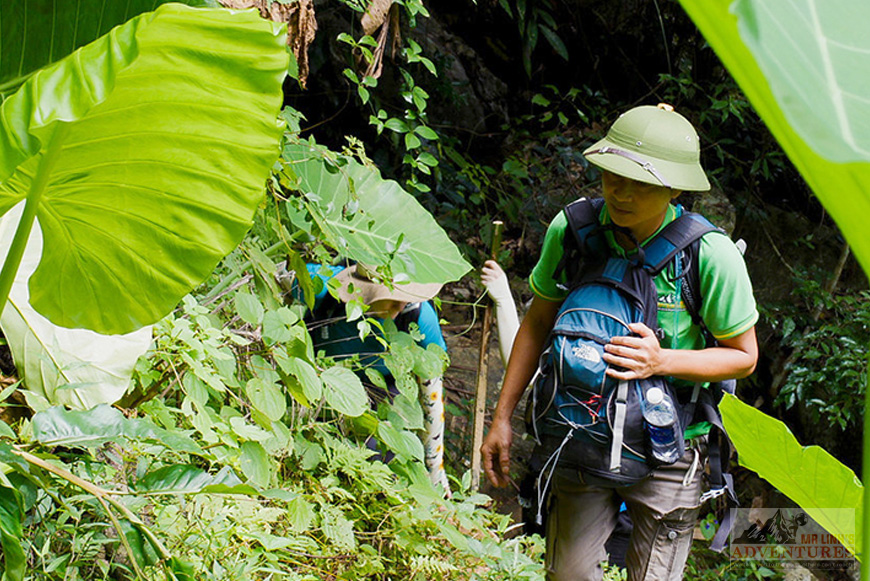 Your guide : Not a new-age guru but a seasoned field professional who knows some truths defy speech | Mr Linh's Adventures
What remains
Back in Hanoi's bustle and then, inevitably, in the domestic clamor that confuses urgency with importance, something in me had changed. I'd learned that trust doesn't require a degree in comprehension: following someone with whom you share neither language nor codes can turn into a comfortable promise. It's not surrender, it's a form of practical faith that says: "I trust you, walk ahead."
I'd also discovered that mime isn't a regression to the age of pantomime, but a refined discipline of attention. Forcing someone to repeat, gesticulate, draw explanations in the air, it's temporarily condemning them to a charming vulnerability. And that vulnerability, shared among two, three, or six, binds people better than a hundred courtesy phrases recited out of politeness. The frank banalities of a common language are worth less than a gesture repeated until understanding.
Then, when I opened my phone after those days of disconnection, a thought crossed my mind like a mosquito with impeccable dramatic timing: all that digital noise - notifications, conversations that occupy space without filling it - isn't that, ultimately, what we're really missing? There's noise, and there's silence that nourishes.
Thanh went back to Ba Bể. He guides other motley crews, modulates his English like tuning an instrument, mimes when needed, stays silent when silence is more relevant. He's neither a new-age guru nor tourist scenery; he's a field professional trained by experience and Mr Linh's Adventures, who knows that some truths refuse speeches. They're walked, breathed, and shared in the complicit laughter of different tongues that, ironically, don't need to understand each other to recognize one another.
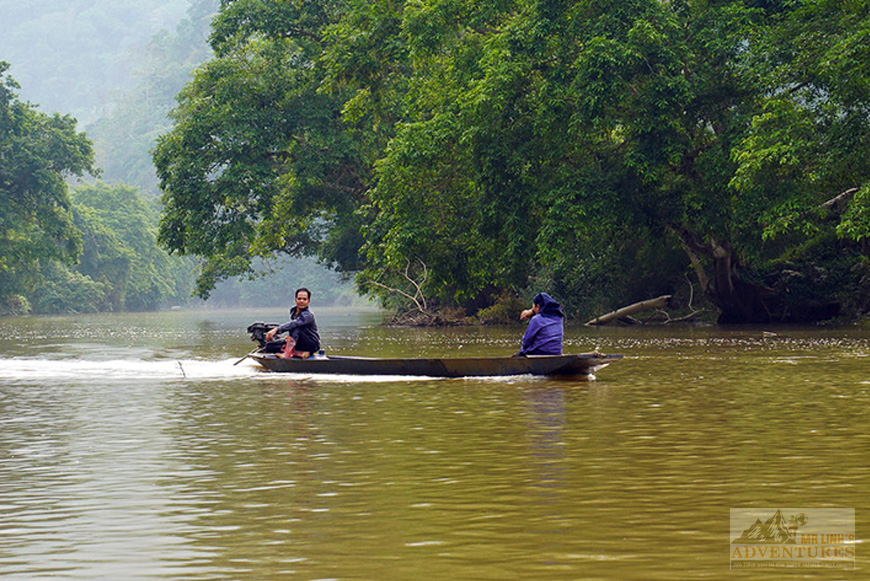 Ba Be Lake needs no long description ; a deep feeling suffices | Mr Linh's Adventures
Experience this
Recommended trek:
Ba Be National Park Trekking & Kayaking 3 days 2 nights |
Ba Be Nature Escape 3 Days 2 Nights
Level: Moderate (4-6h walking/day, elevation up to 800m)
Ideal season: September to November (after rains, golden rice fields) or March to May
What's included: Local English-speaking guide (Thanh or one of his accomplices), homestay with locals, full meals,
transport from Hanoi
What awaits: Hiking between lake and jungle, crossing authentic Tay villages, nights in traditional stilt-house homestays, local cuisine, and that particular silence that comes when words take a vacation.
Talking about guides, have a look at these articles: