Vietnam isn’t changing faces, it’s tipping
Everyone says Vietnam is “changing.” That’s wrong. Vietnam isn’t changing: it’s tipping. Subtle difference.
Brand-new airports three hours from rice paddies where water buffalo still doze, luxury trains rolling through villages that were drying rice not long ago. That contrast, brutal modernity beside deep-rooted traditions, is what makes the country impossible to neatly map. And irresistible.
2026 isn’t “the ideal year” because a TikToker said so. It’s the year several colossal projects finally cross a credibility threshold.
Here’s what’s solid. And what collapses under scrutiny.
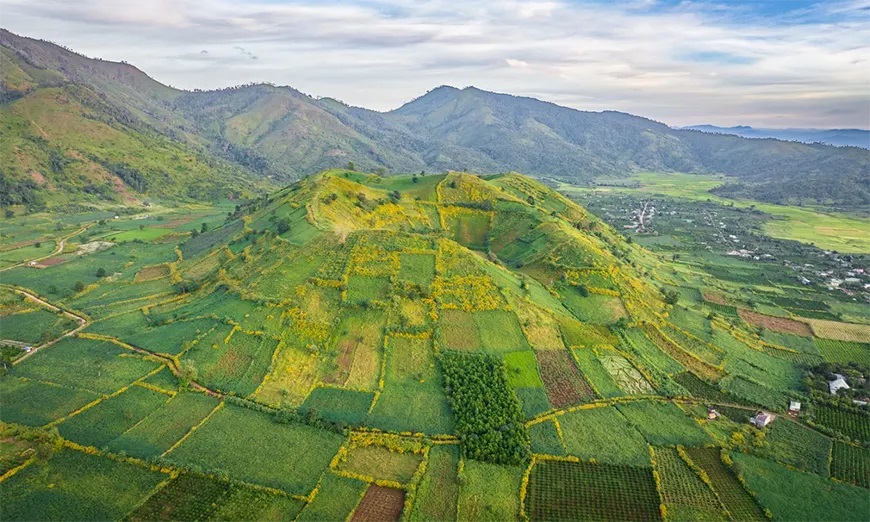 The extinct volcano of Chu Dang Ya - Gia Lai province
Gia Lai: The year the Central Highlands stopped apologizing
The Central Highlands (Tây Nguyên: Gia Lai, Đắk Lắk, Lâm Đồng) used to be Vietnam’s “it’s pretty but complicated” region. 2026 buries that excuse.
As Vietnam’s tourist industry enters a restructuring phase focused on sustainability, regional links, and higher-quality growth (rather than counting visitors alone), Gia Lai, the country’s second-largest province, was chosen to host the national tourism year 2026. Over 200 events are planned across the year, but more importantly, training for local artisans.
Why go?
For the Central Highlands. This is
Jarai and Bahnar country: communal longhouses (Rông), gong festivals (
space of gongs culture : UNESCO), the extinct
volcano Chu Dang Ya, and an ecotourism that’s the antipode of Halong Bay.
Pleiku Airport increases frequencies to Hanoi and Saigon (for those who once dared into the region, expect real regular flights now)
Roads to Bien Ho (T'Nung Lake) and the Chu Dang Ya volcano are rebuilt: no more three-hour 4x4 rides just to see a lake
The mood
Red dirt tracks, top-notch coffee, gong festivals that hit you in the chest. It’s raw, it’s green, and now is the time to go.
Mr Linh's real talk
This isn’t brochure “ethnic authenticity.” It’s a province learning to monetize its culture without Disneyfying it. And it’s still remote enough that you won’t turn a corner and meet a cruise-bus.
 SJourney : the timeless charm of the Indochina-vintage style | Photo : SJourney
The SJourney: When “slow” becomes a strategic premium
Vietage (Da Nang–Quy Nhon) was a test. The
SJourney, now official, is the flex: eight days from Hanoi to Saigon in cabins with private bathrooms, roughly $9,900 per double cabin. Indochina-vintage style, cozy and romantic, a dining car for 60 open 24/7.
What it is
A train-hotel crossing Vietnam north to south: Hanoi → Ninh Binh → Quang Binh → Hue → Hoi An → Phu Yen → Phan Thiet → Ho Chi Minh City. You unpack once. The train stops, you explore, and you come back to sleep in your cabin.
What it is not
A transport option. It’s a mobile destination for people who have already done Vietnam in “one night per city, three temples per day” mode. Excursions are guided, meals are in selected local restaurants, private transfers included. But it’s not “authentic slow travel” mixing farmers and rice paddies, it’s full-on luxury on rails.
The mood
Swap soulless domestic flights for a 40 km/h procession where the scenery smacks you every few minutes, with the comfort of a five-star hotel moving along the tracks.
Mr Linh's real talk
At that price you’re not buying “the Vietnamese experience.” You’re buying the privilege of seeing the country without friction… while the train precisely traverses the country’s friction zones. Luxury slow travel, not community-based tourism with a complimentary massage.
 Long Thanh Airport - Illustration
Long Thanh: The airport that finally relieves Saigon
Fact-checked: on 19 December 2025 a Vietnam Airlines Boeing 787 landed with the Prime Minister and the official delegation aboard. The airport is “technically open.” Regular commercial flights: not before June 2026.
Why it changes things
If you’ve ever been stuck at Tan Son Nhat at 2 p.m. on a Saturday, you know: immigration lines snaking to boarding gates, the concrete heat, the taxi that charges triple because “the meter’s broken, sir.” Tan Son Nhat has been saturated for a decade; “saturated” is an understatement : it’s suffocated.
Long Thanh, 40 km east of Saigon, will absorb 25 million passengers in phase one and eventually 100 million. It’s not a glossy “airport of the future” brochure. It’s massive infrastructure that reveals Vietnam’s strategy: become a regional hub in Southeast Asia, even if you spend 45 more minutes getting to central Saigon.
Bonus: 41 new border posts accepting e-visas, including Long Thanh (from July 2026)
Mr Linh's real talk
Long Thanh doesn’t solve everything. But it highlights a problem Vietnam finally has the resources to recognize — and to start solving. It’s a start.
 An entrance in Hue Citadel | Mr Linh's Adventures
Hue 2026: The Fire Horse and the end of cultural timidity
Hue’s festival suffered from an identity crisis for years: not quite authentic folklore, not fully modern. The 2026 edition buries that ambiguity with an aesthetic declaration.
On 1 February 2026 a monumental Fire Horse sculpture took over the Perfume River bank. Made by Vietnamese, Korean, and French artists, it towers several meters and fuses the Vietnamese zodiac (2026: Year of the Fire Horse) with a baroque-contemporary aesthetic.
What it changes
Hue sheds the “slightly shabby imperial town” cliché. It embraces excess. Let’s be honest: the Fire Horse is not a historical reproduction; it’s what an eight-year-old hopped up on manga would make after touring the Imperial City: flamboyant, impossible to ignore, deliciously kitsch but executed with international resources.
Program
The festival isn’t only the unveiling. Expect reorchestrated traditional music, collaborations between nha nhac masters (court music) and foreign musicians, installations in the Forbidden City gardens. The official theme is “Cultural heritage, integration and development,” which, beyond the brochure, means: we keep our roots and stop pretending they’re fragile.
The vibe
Hue isn’t modernizing with screens or QR codes slapped on emperors’ tombs. It’s resurrecting myths with French welders and Korean sculptors. The result is hybrid, slightly mad, and finally worthy of the city’s over-the-top history.
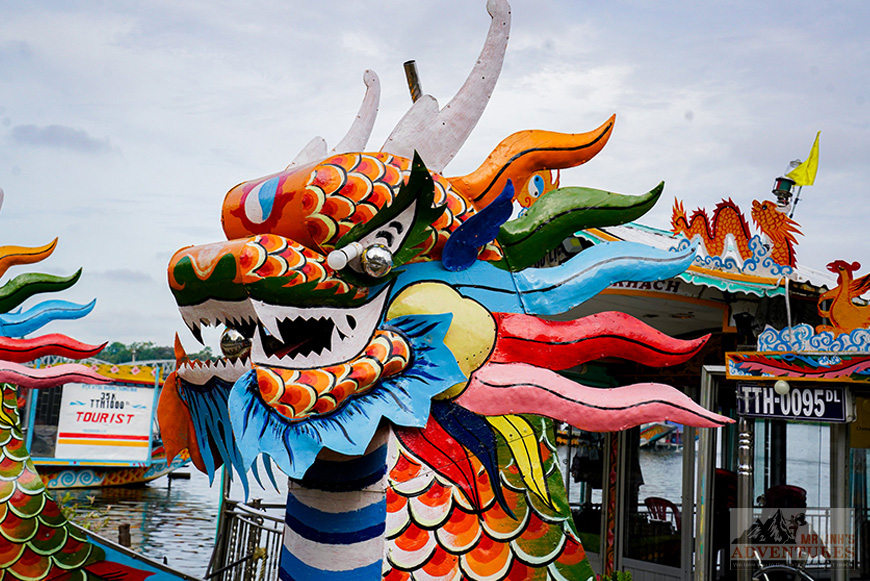 Dragon Boat on the Perfume River - Hue | Mr linh's Adventures
Visas 2026: What really changes (and what people have been told)
Vietnam is an Olympic champion of dramatic announcements followed by quiet postponements. So let’s separate truth from rumor, with sources where possible, on the topic most prone to misinformation.
Verified: Two new long-term visas
From 1 July 2026 Vietnam launches two categories:
- • UD1: for “high-quality talents” (experts, investors, researchers). Duration: five years, multiple entry.
- • UD2: for families of UD1 holders. Same duration, same conditions.
These don’t replace tourist e-visas. They target a narrow population, not you — the average traveler who wants three months sipping a cà phê sữa đá in Hoi An.
Verified: e-visa availability expands by geography
Opening Long Thanh and 41 new border posts means e-visas will be accepted at more entry points. It’s less a reform than a geographic consequence.
What you may have heard: “No more paperwork”
False. The 90-day multiple-entry e-visa has existed since August 2023. That’s not new in 2026. What changes is where you can use it, not its nature.
What someone told you: “Visa on arrival simplified”
Still false. Visa on arrival (VOA) still requires a prior invitation letter via an agency. No simplification has been announced.
Unknowns
- • Application details for UD1/UD2 (what documents? processing time?)
- • Whether on-the-ground visa extensions will become possible (currently: not allowed; a visa run is required)
- • Whether e-visa fees will remain at $25 or rise
Mr Linh’s Adventures advice
Don’t trust bloggers promising “a paperless Vietnam in 2026.” Trust official immigration texts (which change often and sometimes retroactively). Practical rule: check the immigration site one week before departure, not six months.
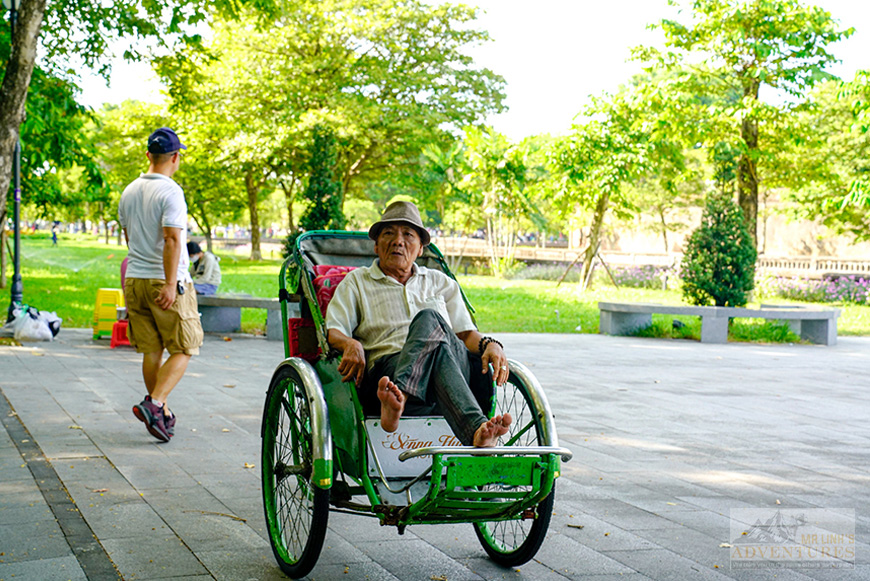 Vietnam Eternal : Pedicab in Hue - Mr Linh's Adventures
Go or don’t go? 2026: the year of credibility
Vietnam in 2026 remains a major adventure destination, if you can read between brochure lines. It’s easier to stay longer, but it’s still intense to manage. Vietnam doesn’t become “the 2026 destination” because it’s new. It becomes one because it reaches an infrastructure density that makes chaos tolerable, and authenticity reachable without surrendering comfort.
The question is no longer “Can I endure 12 hours by bus to see an incredible view?” It’s “Will I pay $10,000 to avoid seeing the bus at all while crossing the same landscapes?” Both answers are valid.
And that's the real plot twist of Vietnam 2026.
Going further: