“Let life happen to you. Believe me: life is in the right, always.” (Rainer Maria Rilke)
I simply want to let it all happen. Not knowing what the day will bring, especially here in remote northern Vietnam, where we’ve just crossed the halfway mark of our journey. We’ve slipped into a quiet flow. Rice twice a day feels natural, a shared corridor shower is no issue, and walking uphill to a homestay without an elevator feels completely right.
We wake up in Mường Khương, a town of 10,000 where every passerby greets us. That alone makes the day. Our hotel isn’t built for tourists - it doesn’t even serve breakfast. So we improvise with food our guide David bought locally, eating in a nearby café. It reminds me of old Austrian Heuriger taverns: bring your own food, drink the local wine. No jam on the table, because nobody here eats jam. And that’s perfectly fine.
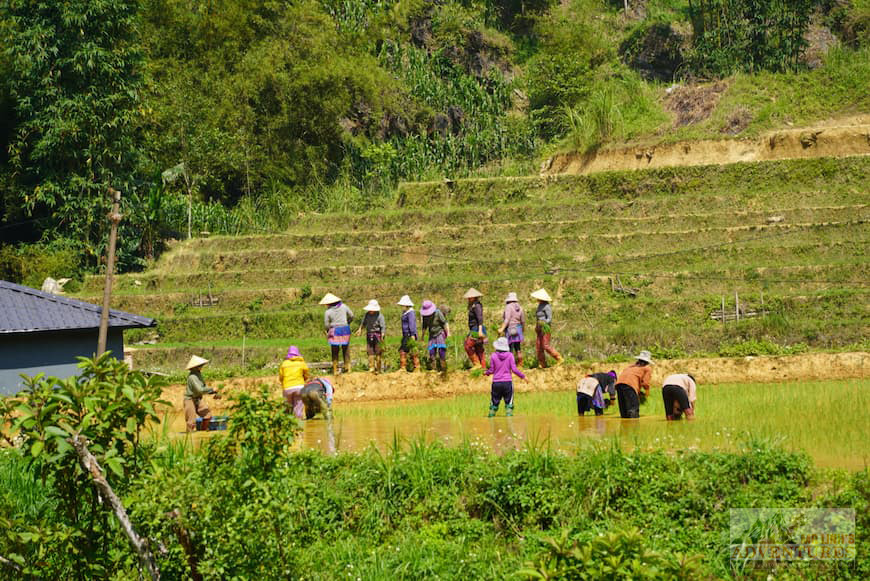 Transplanting rice in the flow of life | Mr Linh's Adventures
The dragon-tooth mountains and the Nùng people carried us gently through the morning. Seven kilometres of walking, starting with an encounter I won’t forget. We stop at a traditional bamboo-and-wood house. The parents are in the fields, but the head of the household is an eight-year-old boy. He welcomes us into the yard, shows us the ancestor altar, gives surprisingly adult commands to his dog, and answers our questions with quiet confidence. When Valeria offers him coloured pencils, he firmly refuses. “Why?” David asks. “Because I already have five.” What dignity, what conscious modesty in a child.
The day keeps unfolding. A woman selling soup from a plastic bag invites us to taste men men (corn and soy broth) and bánh đúc (a savoury tropical jelly). How many of us are truly ready, in that moment, to let life happen completely? To step off the familiar shore and enter another history, another climate. Later, a man invites us into his earth-floored home, demonstrates the bamboo water pipe, and tells us he still prefers it over his new cement house because the old one is HOME - written in the genes of generations. While waiting for the bus, a grandmother waves us into her shade. Fifteen of us, invited to rest, take photos, stay for half an hour. They aren’t disturbed. They feel honoured. And so do I. Every single person we pass offers water. “It’s very hot today,” they say. Each of them cares.
The bus ride to Pha Kha is an adventure in itself. How do they drive here? How do trucks pass over ravines without falling? Then comes the boat on the Chảy River at peak heat: cliffs, external stalactite-like rocks, tiny villages accessible only by water. “It’s like Apocalypse Now,” Giuseppe says. Life delivers a Flower H’mong homestay, the best welcome tea, a perfect lawn to reconnect with the earth, an eight-year-old playing the khèn, a spontaneous Italian pizzica dance, and cicadas landing on the table like tiny helicopters during a late-night call, surrounded by rain. A lot of life happened to us today.
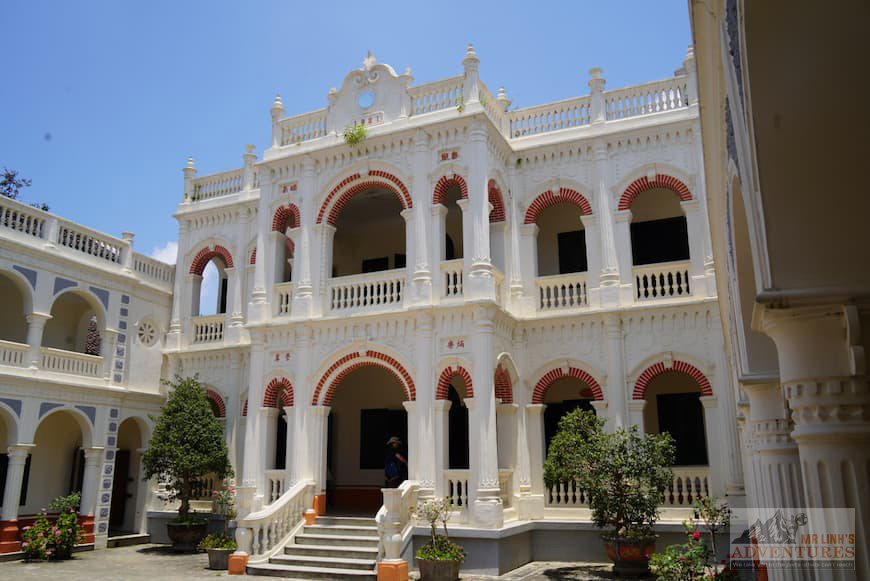 A palace for a so-called King of Hmong | Mr Linh's Adventures
“Not all heroes wear crowns.” - Anonymous
The next morning begins above Bắc Hà, walking among Flower H’mong women in costumes woven with exactly five colours - one for each element. We learn about corn wine, visit a home where the top student in the area lives, and admire toddy palms stretching skyward. But today isn’t just discovery. It’s also a brush with Vietnam’s harder realities.
Our walk ends at the palace of the so-called H’mong King. We didn’t know his story until David explained it. A local leader who, in the early 20th century, encouraged opium farming under French colonial support. It kept populations divided and weakened the nation. He was, in truth, a narcotics trafficker. Today, the palace is a historical monument. To me, it feels alien. “The French also kept Vietnamese people away from education,” David adds. “They wanted us to keep working for them.”
Our guide David embodies the quiet resilience that defines this place. Born in a village, he refused to stay a farmer. “I went to Hanoi to study English. I worked in hotels and restaurants to pay for it. My mother cried, thinking I’d struggle. But I became a guide, sent money home, and funded my siblings’ education. In Vietnam, we say: if you want to change your life, study. Study, study, study more.”
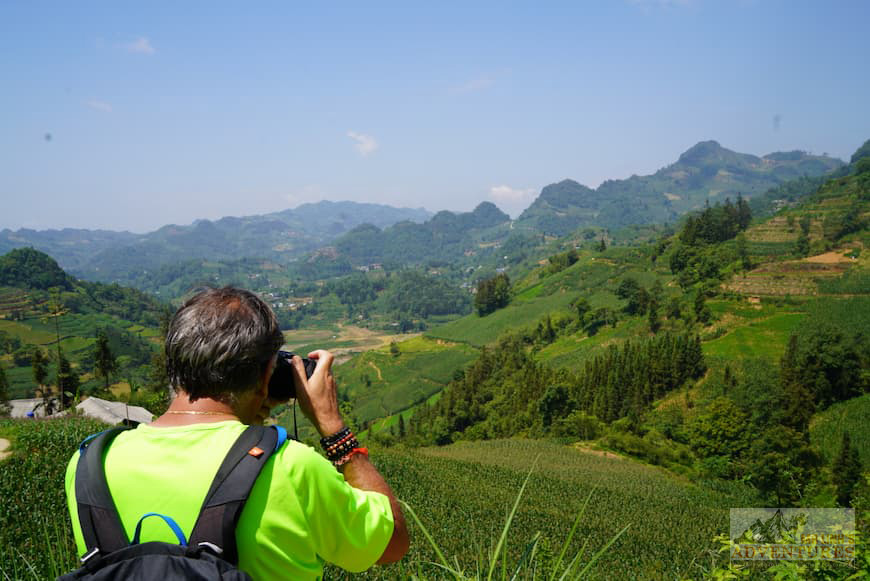 Spectacular views of Northern Vietnam | Mr Linh's Adventures
The real hero of this day isn’t a king. He’s sitting quietly behind the wheel: Duy, our bus driver. From this palace, we face 120 kilometres that take nearly six hours. “Today we have a good road,” David says. Ten years ago, there was no tourism here because there was no road. This “good” road means asphalt in theory, more holes than pavement, and passages that barely fit our bus. Yet we pass countless trucks, moving slower than a hiker. And still, it’s a good road - because it leads to places few foreigners ever see.
Vietnamese driving has amazed me from day one. It looks chaotic, but it’s actually a language of care. The horn isn’t aggression; it’s communication: “I’m here.” “Go ahead.” “Let me pass.” Hundreds of tiny signals. Even a chick crossing the road is accounted for. Duy guides us through these landscapes with Olympic calm.
Looking at these roads, I finally grasp how essential community is here. Tropical climate doesn’t mean easy life. Violent rains wash out paths. Villages get isolated for days. People depend on each other. They are all everyday heroes.
As a reward, we end the day high above the valley, landscape resting in our hands: Dao villages, rice fields, 400-year-old tea plantations, water buffaloes. People who venerate the sun because it’s scarce in the mountains. “My keyword for today is the road,” Morena says. “The road that takes us on a journey, and the road that brings us back home.”
Then, a violent thunderstorm reveals the magic of the hills before striking the power grid. The light bulb flickers out. I’m left in darkness.
Good night.