.png "Eating on the streets") Eating like a local is about immersing yourself in shared moments - Mr Linh's Adventures
Eating like a local is about immersing yourself in shared moments - Mr Linh's Adventures
You’ve probably been told before that to truly understand Vietnam, you have to "eat like a local". It’s a phrase that’s easy to say, but one that hides a world of complexity and small mysteries, much like the murky depths of a good soup. The traveller, armed with their camera and their illusions, believes it all boils down to just ingesting a few exotic dishes. Poor guy. In truth, it’s a matter of etiquette, history, and pure instinct. Follow me, and I’ll explain!
The street, temple of gastronomy
The street, you see, isn't just a place to get from A to B. It’s the beating heart, the great organ, the very soul of Vietnamese gastronomy. This is where the real food is found. Forget the tourist restaurants and charge headfirst into the tiny street stalls. You'll spot them easily by their miniature plastic stools and the crowd of locals jostling for a spot. Eating on the street is a total immersion. The food is prepared right in front of you with ultra-fresh ingredients. It's also where you'll find the lowest prices and where you can connect, even if it's just with a smile, with the locals.
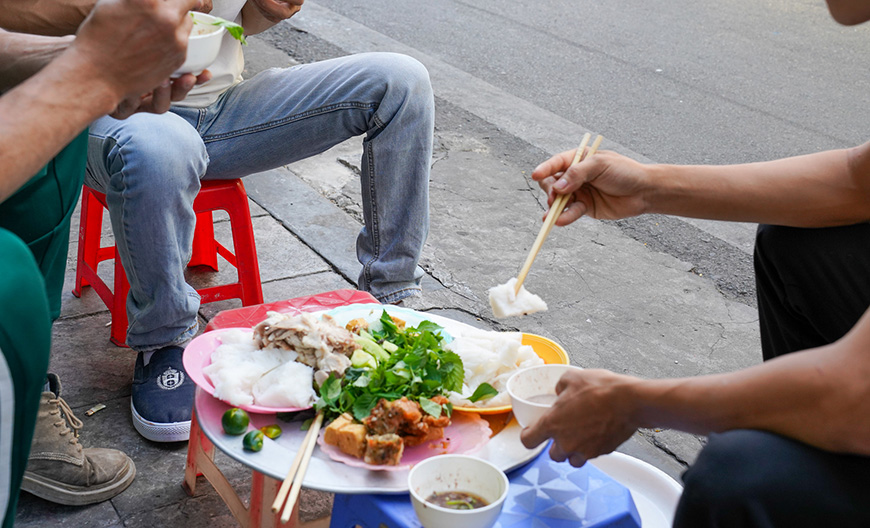 Tiny street stall, emblem of street food in Vietnam - Mr Linh's Adventures
I'm often asked why one eats in "tea party" mode in Vietnam.
The tiny chairs and tables are one of the first things people notice. Vietnamese culture, influenced by Confucianism, values a respect for space and modesty. Eating at a low height is a nod to humility and encourages togetherness around a shared surface. From a practical standpoint, it's nothing more than urban survival engineering : the tables, the size of a shoebox, let vendors maximize space and can be stacked in a flash if the city patrol, dreaded by all, decides to do a sweep.
To avoid making a mistake, follow the crowd: a busy stall is always a good sign. It’s a guarantee of good quality and a quick turnover of products. If the language barrier is a problem, just point to the dish you want.
The three meals of the day
Unsurprisingly, here too there are three main meals: breakfast, lunch, and dinner.
Breakfast is eaten very early, often before 6 a.m. No chance of a croissant or coffee with milk here. Instead, you’ll find savoury and spicy dishes, like Cháo Gà (rice and chicken soup), Bánh Bao (meat-stuffed bun), or even Phở or "white ravioli" (Bánh Cuốn). There's also a multitude of sticky rice dishes, wrapped in a banana leaf, called Xoi.
Lunch continues to smell good in the streets around 11:30 a.m. It’s usually a single, energetic, and fragrant dish, eaten at the office, brought from home, ordered for delivery, or enjoyed during a proper break outside. It's the chance to enjoy a meat-based dish (pork, beef, chicken, duck), served with tofu, vegetables, and plenty of herbs. Off the top of my head, my favourites are Bún Chả, Chả Cá, Bún Cả (grilled fish), and for special occasions, the endless combinations of hot pots (Lẩu).
As for dinner, it’s shared with family or friends, by ordering several dishes and placing them in the centre of the table. Rice is the foundation of almost every meal.
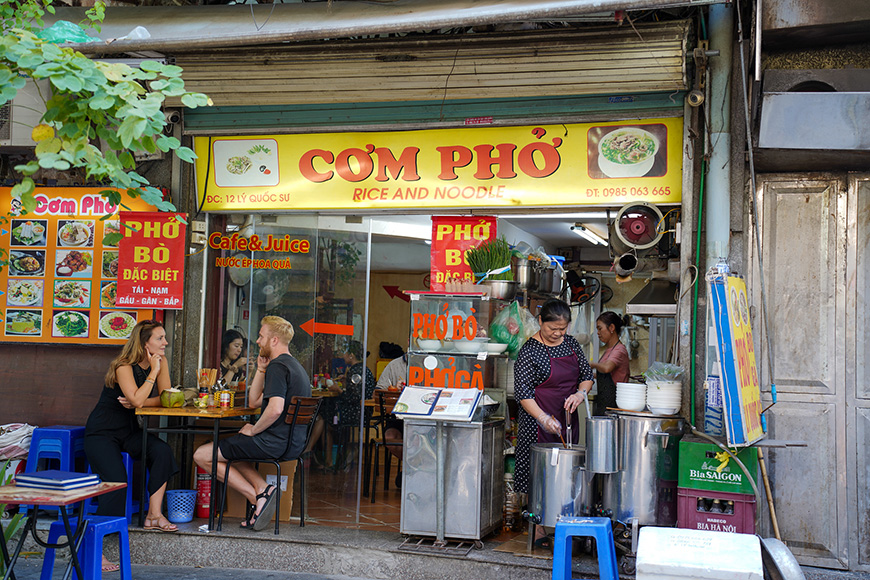 Enjoying a morning Pho in Hanoi's Old Quarter - Mr Linh's Adventures
A traveller's survival guide to the table
Eating like a local also means adopting local habits. The unwritten rules of pavement dining are simple and forgiving, especially for newcomers.
Why wipe your cutlery?
You'll often see locals giving their chopsticks, spoon, or even their bowl a quick wipe with a tissue before they start eating. It’s a habit that might be surprising at first, but it comes down to a simple matter of hygiene. It's a way of ensuring the cleanliness of the utensils, even though they are washed frequently. What’s more, it's customary for the youngest person at the table to wipe the utensils for their elders, which is a lovely sign of respect.
The toothpick custom
Don’t be surprised to see toothpicks appear on the table at the end of a meal. In Vietnam, it’s a completely normal and polite custom, often done while covering your mouth with a hand. By the way, they are never given hand to hand. They are placed on the table for the person to serve themselves.
The "eat first, pay later" rule
Place your order, then choose your own table and matching stool. Once you’ve finished eating, place your chopsticks on top of your bowl. To pay, ask for the total before you leave. All you have to do is say "tính tiền" while waving your hand (that’s "the bill, please"). Don’t expect a written bill; it’s normal to trust the vendor, who is used to remembering everything. It’s a matter of confidence, a faith in the system that would be quite useful elsewhere, under different skies.
%20(1).png "Savor local food") Eating local food like a local - Mr Linh's Adventures
Eating local food like a local - Mr Linh's AdventuresChopsticks have a soul
Never, ever stick your chopsticks vertically in your bowl of rice, unless you want to invite wandering spirits to your table—or, more likely, to earn yourself some seriously embarrassed dining companions. This gesture is associated with funeral offerings and is considered a sign of very bad luck.
Sharing is caring
In a restaurant, several dishes are ordered and placed in the centre of the table for everyone to share. Rice is the foundation of almost every meal, and each person generally has their own bowl of it.
Table etiquette
Meals are sociable occasions where the elders are served first and they are the first to start eating. You don't wait to say "enjoy your meal". You simply wait for the head of the family to give the signal. It is polite to leave a little food on your plate to show that you are full and no longer hungry.
Practical tips
Forget the Western notion of appetizer, main course, and dessert. Here, all the dishes are eaten at the same time, and there are very few desserts. If you are invited and are being very, very polite, use the opposite end of your chopsticks (the "handle" side) to slide over chillies and other more or less identified trinkets. This is also what's done if you've got a cold. And don't try to choose which dish to eat first. It will most certainly be the one you thought was a dessert.
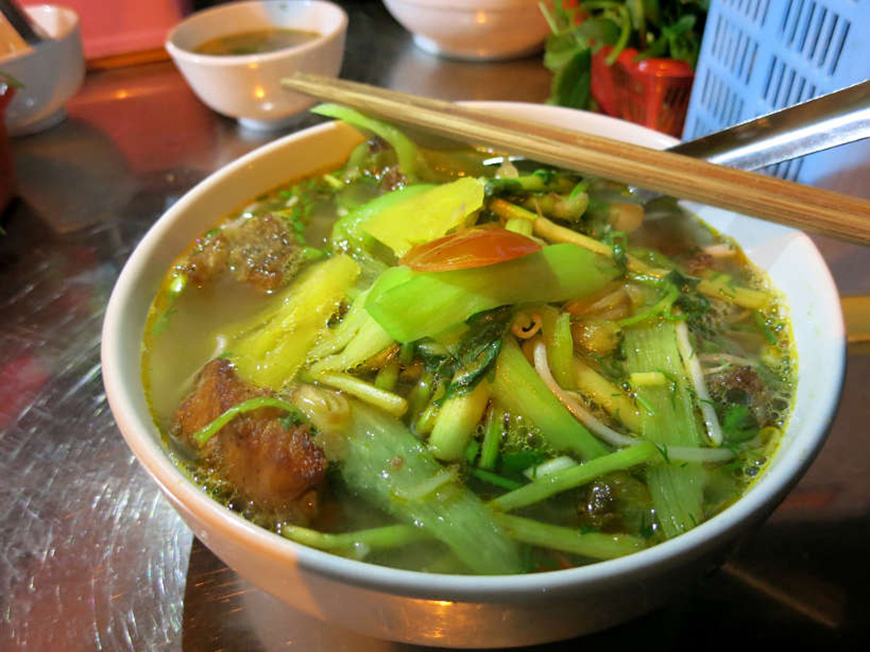 Did you ever tried Bun Ca ? Mr Linh's Adventures Team
Eating, a story of life
Eating in Vietnam isn’t a singular event; it’s a series of snapshots.
It’s the morning bowl of Phở that helps you discover the "taste of the morning" from the street. It’s the lunchtime Bánh mì that reminds you that bread, once reserved for the elite, was supposedly "decolonized" by the youth (according to one urban legend…). And it's the Chè at nightfall, that deliciously regressive snack like a final reminder of childhood.
Eating like a local isn't just a matter of taste. It's a common thread that connects generations, small conversations, and rituals of gratitude.
I'll tell you an anecdote, about my first bánh cuốn.
She had me come in and sit down while she prepared them. A cat so thin you'd have sworn it was a squirrel came to settle on my lap, all under the smiles of a boy who watched me, amused, as I downed a tea that would strip any floor tile.
I felt good. Especially since my notions of hygiene in a restaurant setting had already passed away suddenly when I saw a young girl doing the dishes on the pavement, while her older sister bled a chicken with the sadistically nonchalant grace of someone who's about to make a good profit.
Yes, I felt good, trying to babble a few words of Vietnamese while the pimply server blushed, timidly yet brazenly attempting a "hello!".
I was mesmerized by the mother’s fascinating ballet as she spread the bánh cuốn dough on the wicker, all while scolding her sleeping husband (he’d just fallen off the mezzanine, following a thunderous "Anh Oï!" that would have woken up even Joan of Arc's libido if she'd decided to vacation here instead of getting into a famously toasted pickle).
Then she asked me if I wanted a sauce with it—yes, I would. She had a smile so bright you forgot she had one eye that was rinsing the rice while the other sorted herbs.
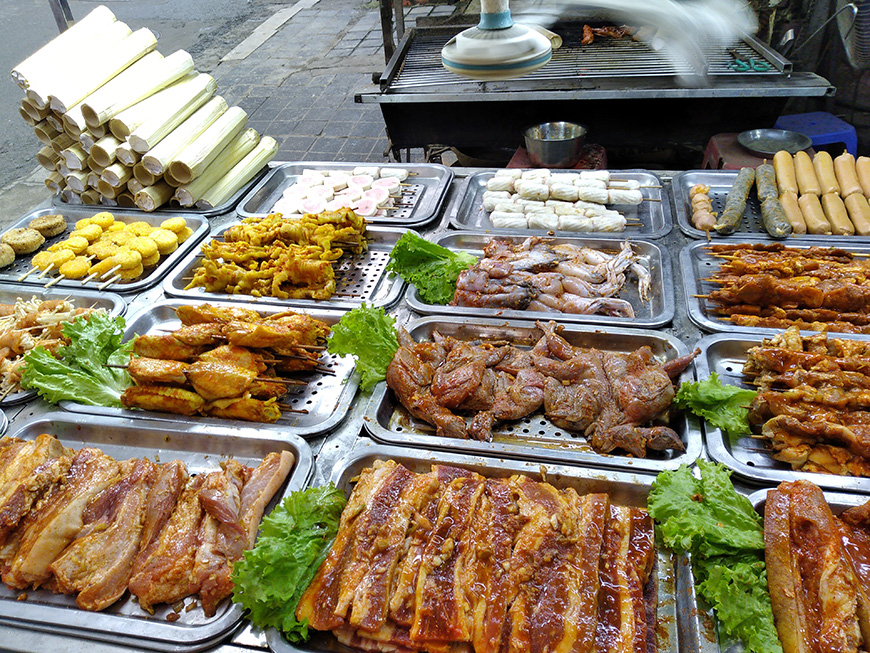 If you don't know how to order, just point the dish you want - Mr Linh's Adventures Team
You see… Eating like a local is about immersing yourself in these shared moments, where every dish holds a story and every woman-cook-vendor becomes the guardian of a culinary memory.
It's the best way to truly live Vietnam from the inside.