I'm not going to lie to you: Vietnamese street food is not a temple. It's not a gastronomic ashram where one meditates while chewing.
It's food, prepared quickly, swallowed even faster, served in a rather unforgiving theater: heat, smoke, pollution, microbes working as a team, and sometimes a passing dog diligently practicing the art of urban spraying thirty centimeters from your stool.
Let's not misunderstand: I am a fan of street food. But let's stop selling it as a mystical experience.
The truth: it's good, cheap, and gives an unfiltered glimpse into daily life.
The lie: believing it's safe because "the locals eat it."
Here is a little guide to the warrior microbiome.
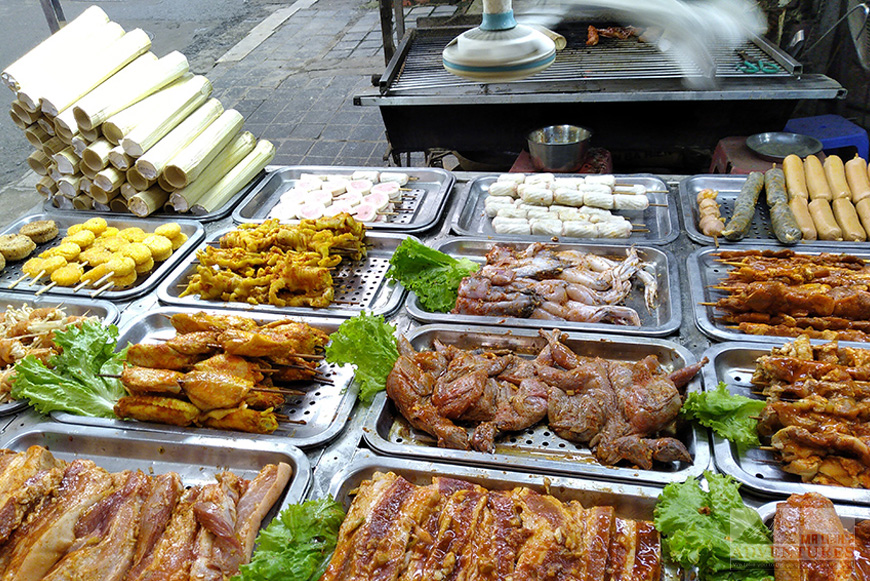 You look, you salivate, you don't dare. You feel a bit cowardly. That's normal | Mr Linh's Adventures
Relearning to eat with your body, not your Insta feed
Real issue: we've lost the art of sensory evaluation. We photograph a dish before even smelling it; we consult Google Maps like an oracle, then check if the dishes are drying in the sun or ending their life in a basin of grayish water.
Common thread: the instinct of the hungry predator. Before every dish, a mini instinctive investigation takes place, silent, fast, implacable, as if your belly wore a monocle and carried a notebook:
- Why this stall and not the other? The line of office workers? The smell that attracts rather than repels you? The sharp clap of the sizzling wok? Clues as reliable as a compass.
- Why now? (Lunchtime = turnover = freshness). At 2 PM, the same dish has spent three hours under a plastic tarp.
- Why this specific dish? (Boiling: defense mode activated. Cold and pre-prepared: food Russian roulette).
This isn't exotic paranoia. It's field reading, the same little science that allows you to cross the streets of Hanoi without ending up as confetti.
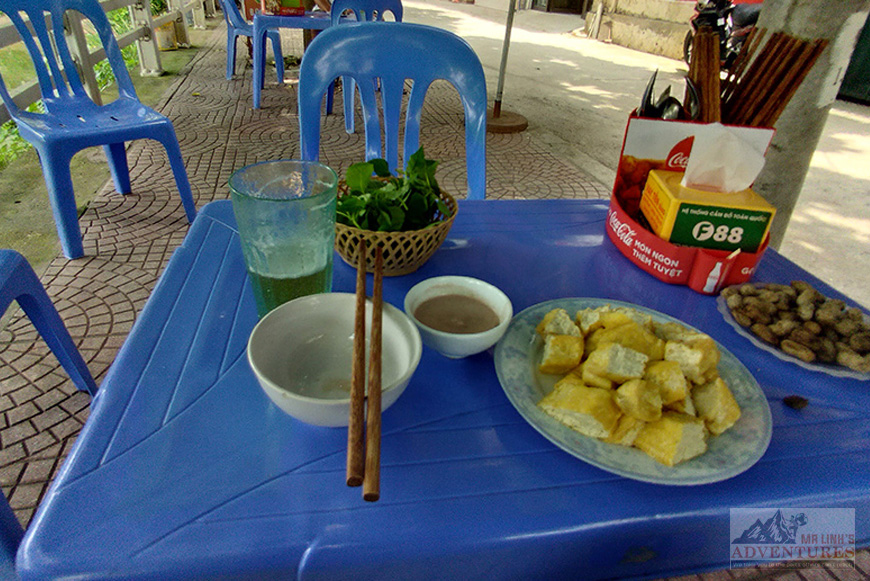 If it stinks but makes you want, then it’s good! Fried tofu with fermented shrimp sauce | Mr Linh's Adventures
The false magic of "why them and not me"
It's not a tribal blessing nor a superior immunity: locals are not invincible endowed with a shield as ancestral as it is supernatural.
No, just microbiome marathon runners. Their gut flora has been training since childhood, like a runner who chained kilometers before even your first Sunday jogs.
You, on the other hand, arrive as a tourist sedentary version, and want to go the distance without preparation. Your Western microbiome, unfortunately, often resembles a team of rookies:
- -Less diversified (antibiotics, industrial junk food),
- -Naïve facing local strains of *E. coli*, *Campylobacter*, *Salmonella*,
- -Undertrained for "wild" microbial challenges.
In short: it's not mysterious fate, just physiology. And in cooking as in sports, training counts more than superstition.
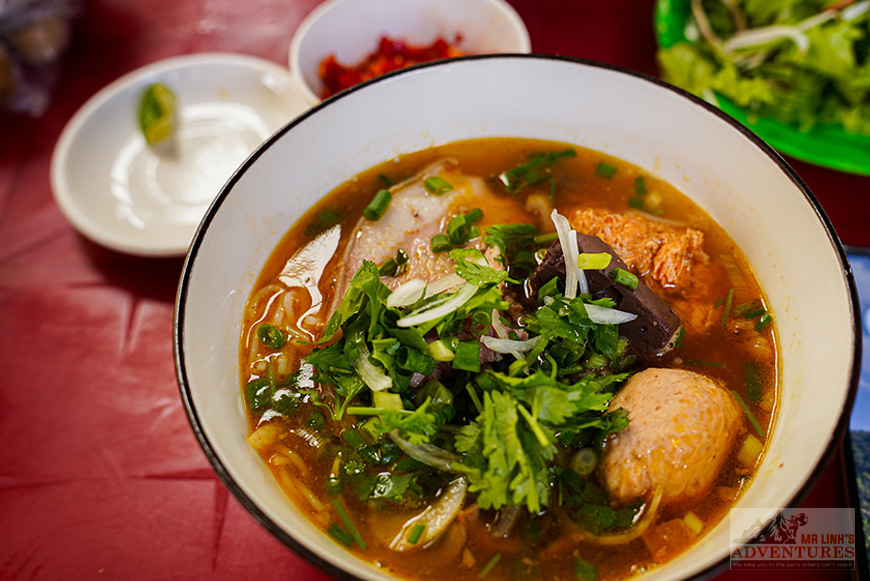 Bun bo Hue, a starter kit for street food | Mr Linh's Adventures
The intestinal bootcamp: dirty, real, progressive
Week -4: Recruit your intestinal militia
No probiotic capsules from the supermarket, but real controlled dirty eating. Massive fermentations for live bacteria taking possession of the terrain: spicy kimchi, creamy kefir, sparkling kombucha, raw sauerkraut. Or raw milk Camembert that still smells like the barn (our French readers will understand).
Targeted loot: a dense microbial jungle. The more species in competition, the more any pathogen arriving will have to fight for a spot. This isn't armor, it's a compact crowd preventing the pickpocket from circulating.
Medical disclaimer: if your immune system shows obvious signs of great laziness, consult a doctor. This bootcamp is for guts in working order.
Day D: Infiltration into unknown territory
The first two or three days, you are a gastronomic spy. You look, you salivate, you don't dare. You feel a bit cowardly. That's normal. But observe well what you refuse: is it the very local version of hygiene that repels you, or the fear of the unknown?
Learn to distinguish. The grimy stall with a long line of office workers: probably safe. The empty and clinical stall, with a waitress in latex gloves: suspect. Perfect hygiene can hide a lack of customers, therefore turnover, therefore freshness.
Then, you start. Not just anywhere: where heat is your natural antibiotic. *Phở, bún bò Huế, cháo, bún riêu*… Look for stalls where local families lunch with their children; they don't take risks with the little ones' health.
Drink lukewarm. Not ice-cold. Thermal shocks don't please your microbiome, which prefers lukewarm diplomacy to cold blows.
By the fifth day, you start negotiating with destiny: the bánh mì from the guy slicing the pâté in front of you, who assembles it under your eyes, who watches you eat to see your reaction. The gỏi cuốn where you see the herbs wavering in the clear water, those are good plans.
Listen to the signals: slight change in transit: normal adaptation. Pain, fever, liquid diarrhea: immediate stop, no heroics.
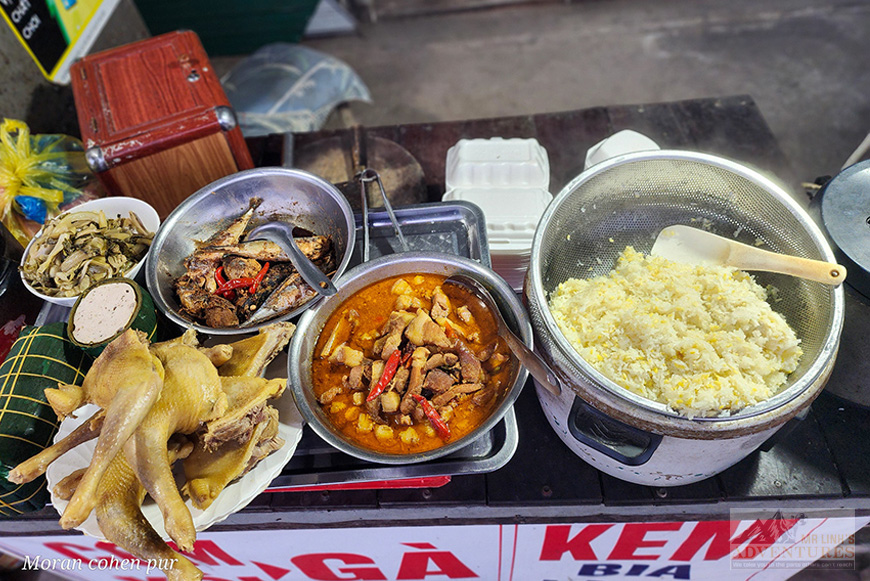 Is your stomach trained enough for a harmless Com Ga (Rice with chicken)? Mr Linh's Adventures
The "gut feeling", when your second brain speaks
Your intestinal intuition is real: the enteric nervous system (this "second brain") dialogues with your microbiome. The intestine contains about 500 million neurons; it doesn't "think" like the cortex, but it constantly calculates: pH, textures, surface tensions, chemical signals of microbial stress.
If your stomach knots up in front of a stall, take it seriously. This bad feeling isn't free fear but an ancestral radar. It spots signals the conscious mind misses: a fermentation smell that makes you grimace, a sticky film on the dishes, the absence of clattering and curses from a busy kitchen (silence = dish prepared in advance = roulette).
Trust two simple reflexes:
- It smells strong but makes me hungry": you can bet on a live and controlled fermentation, a rather safe bet.
- "I step back without knowing why": your enteric nervous system saw something your consciousness hasn't named yet: step back.
Listen to this little biological committee: it has the experience of an old seasoned backpacker and the raw poetry of a teenage poem.
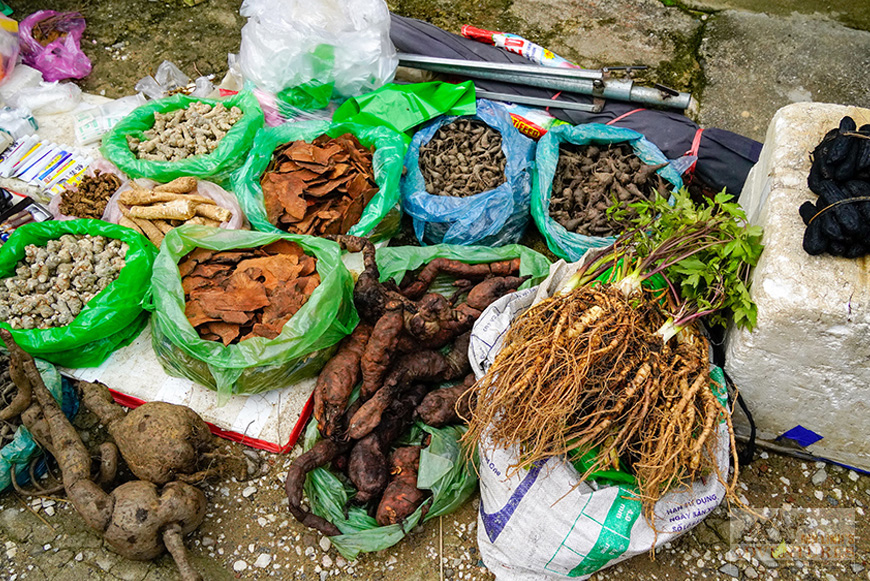 The local products can be somewhat... strange... | Mr Liinh's Adventures
Plan B, if despite everything…
Local green tea (trà đá) and its ice cubes is often the first diplomacy test for a beginner microbiome. So, just in case, at the bottom of the bag, make some space for:
- Saccharomyces boulardii: probiotic yeast that resists antibiotics (if you have to take them)
- Oral rehydration salts: the WHO formula, not sugary Gatorade
- Vegetable charcoal: for food toxins, not for viral infections
To not stay hungry
Your stomach is not a hero. It's an ecosystem. It doesn't deserve your Instagram posts, it deserves your silent listening, your calculated trust. And your audience, sometimes.
Eat the street food. Love it.
Bon appétit! Or not. Your stomach will know ;-)
Still hungry ?