"Cycling in Vietnam is easy…" Really?
You've seen that Instagram photo. The cyclist beams. The helmet gleams. The rice paddies are improbably smooth. The sky has been filtered through "sustainable happiness".
Remember this: cameras lie. Vietnam never does.
It simply watches you pedal through humidity that would make an umbrella sweat. With a gravity that offers no concessions. And a traffic flow that follows rules written in a language no one has ever formally translated; but which everyone reads like a grandmother's recipe: by instinct, and always adding a little more chilli than strictly necessary.
Cycling here isn't about bravery. It's about physics. Fundamental mechanics. Logistics that always demand a spare inner tube and a discreet prayer to the tyre deities. And a pinch of meditative philosophy.
At Mr Linh's Adventures, we've wandered these roads long enough to establish one reliable statistic: what breaks first is rarely the bike. Usually, it's the illusion that you can control everything.
Promise kept for this article: no pub poetry, no marketing catalogue. Just field-tested feedback and advice that protects your knees, your battery, and your dignity.
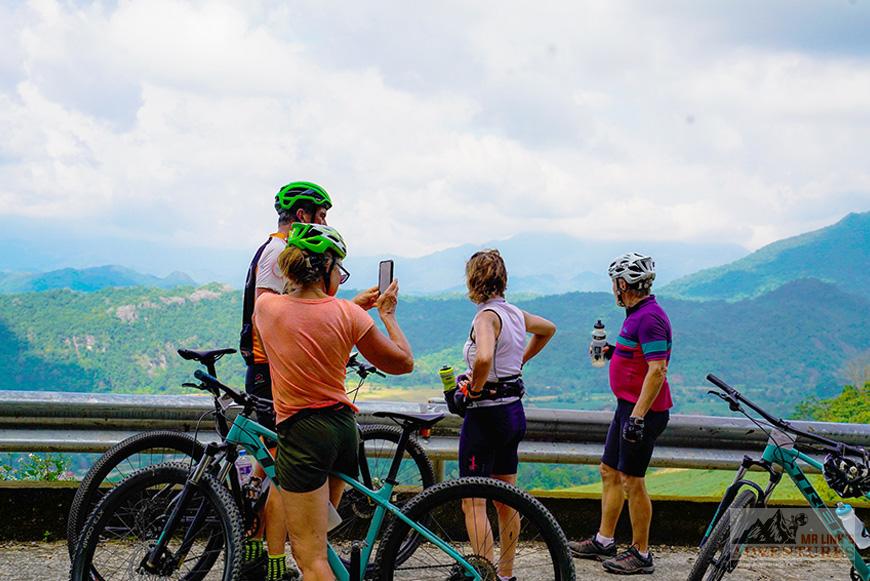 Vietnam is NOT a flat country! Mr Linh's Adventures
Myth vs Reality: What they don't tell you
Vietnam is flat
False. The Land of the Dragon read the definition of "topography" and decided to take it seriously.
Between the northern passes (Ha Giang, Sapa), the central climbs (Hai Van Pass, Lang Biang), and the undulating roads weaving between villages, local gravity operates without a smile: it reminds you of your place with every pedal stroke.
Altitude + humidity = perceived effort ×1.8. Your fitness tracker, polite but naïve, will display an average; your lungs, meanwhile, will begin a trembling lament.
You can recharge anywhere
Technically, yes. Vietnam runs on 220V from north to south.
Practically? Your battery is a sensitive organism that despises heat, loathes humidity, and resents being stuffed in a zipped bag while it digests its electrons. Allow 4–6 hours for a full charge, add noticeable weight, and the non-negligible possibility that the socket was installed by an optimistic electrician in 2008. It recharges, but demands respect, time, and regular supervision. A bit like a Tamagotchi.
Traffic is organised chaos
It is organised, admittedly. Just not organised for you.
Rules are implicit, braking distances are calculated in centimetres, and lorries overtake with the grace of an elephant in a tutu. Motorbikes honk, but it's less an aggression than a system of sonic coordinates: "I am here, you are there, we will cross paths, don't change a thing." Riding in Vietnam requires less reflexes than social reading skills. As for indicators? They're treated as artistic suggestions: occasionally appreciated, rarely followed.
E-bikes are cheating. Mechanical is for the real deal
False. Or rather: irrelevant.
This is a sectarian debate imported from Europe. There, mountain passes are engraved on palmarès. Strava is read like scripture. In Vietnam, the mountain doesn't ask for your pedigree. It simply asks that you reach the summit before the monsoon decides your schedule.
We've seen mechanical cyclists melt into tears at km 30 of a 12% incline, 38°C and 90% humidity, muttering dazedly "it's beautiful" like a prayer without faith. We've seen e-bike adventurers discover that a dead battery at 1,200m transforms 25kg of technology into a stubborn dumbbell. Both were mistaken. Not about bikes in general, but about choosing the wrong bike for that day, that terrain.
Vietnam isn't a criterium: it's a brutal dialogue with slope, heat, and occasionally a buffalo crossing without warning. The right choice isn't the one that dazzles your followers. It's the one that leaves you, upon arrival, with enough energy to accept a farmer's offered glass of tea and smile in silence. That's the journey; not the counter, not the hashtag; just the glass of trà đá.
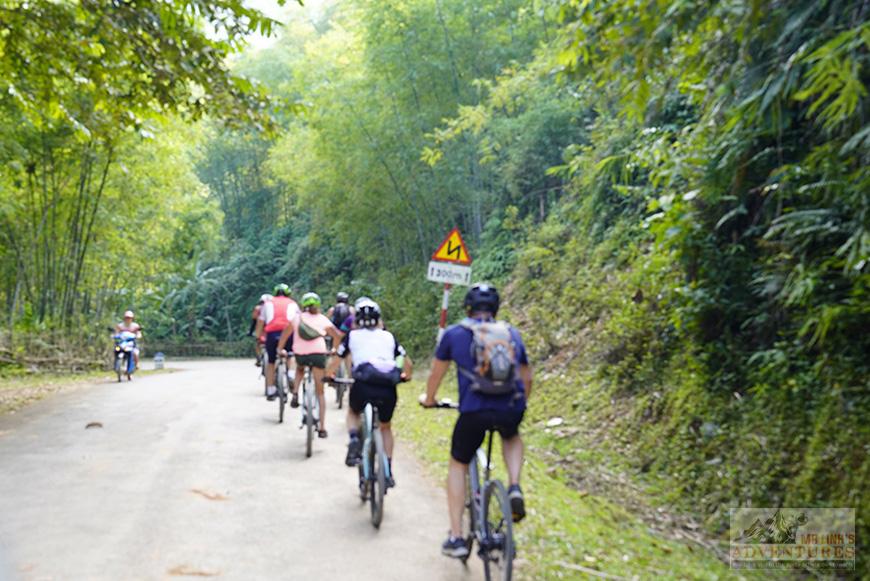 There is no absolute winner between mechanical and electric | Mr Linh's Adventures
The mechanical bike: The purist's choice… and the sturdy
Despite progress's tireless efforts to ruin everything, one object still endures: the mechanical bike.
Weighing 10–14 kg, it asks for no socket, and can be repaired in any village workshop by a man named Hùng (or local variant) armed with nothing but a set of spanners, a cigarette end, and an intuitive understanding of mechanics that Newton wouldn't have dared publish.
The advantages? Lightness. Simplicity. Universal repairability. Controlled cost. Pure sensation. You pedal. The world turns. Literally. And without software updates. No gauge to monitor. No cable to protect. Just you, the road, and good old-fashioned physics.
The limits? Heat offers no gifts. Neither does topography. With luggage (even light), realistic daily distances hover around 30-40 km. Beyond that, you leave cycle-tourism and enter a discipline uncomfortably close to FitCrossing.
For whom? Trained cyclists, lovers of radical slow travel. Short stays, tight budgets, or those who still believe virtue flows through sweat. (Spoiler: it flows mainly through hydration.)
Mr Linh's no-nonsense tip: Hydraulic disc brakes mandatory. Robust derailleur. Puncture-resistant tyres. And accept, once and for all, that Vietnamese romance is experienced in a soaked T-shirt. No shame. Just respect for the laws of thermodynamics.
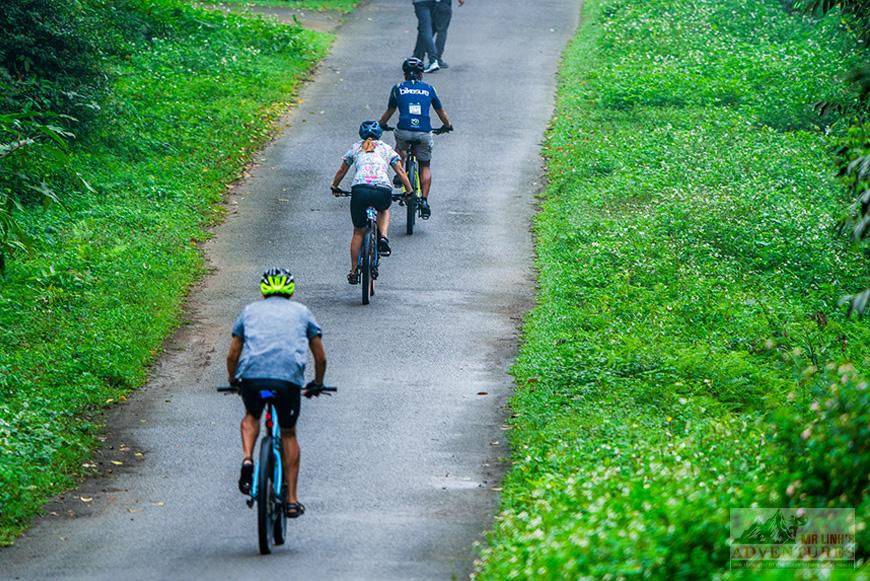 Cycle-tourism isn't about stacking kilometres;it's about listening to the road | Mr Linh's Adventures
The E-Bike: Game-changer… or false good idea?
Electric assist didn't invent the pleasure of pedalling. It simply democratized it.
In Vietnam, where passes attack without warning and humidity files a complaint against every garment, the e-bike often transforms an expedition into a pleasant ride. Well, a well-organised pleasant ride.
The advantages? Topography ceases to be a sentence and becomes a polite suggestion. You cover 50-80 km/day without turning into a salt statue. Less fatigue = more stops, more exchanges, more time to look. Ideal for heterogeneous groups, families, or those who prefer to live the journey rather than survive it.
The limits? Weight (20–25 kg). This isn't a toy. It's furniture. Specific maintenance (motor, controller, battery). Heat and humidity take a marked toll. Elevated theft risk in urban areas. Unreliable recharging off main routes. If your battery decides to strike at 400m altitude, you'll rediscover the laws of gravity with mathematical precision. Carry the bike over a dyke? Load it into a local minibus? Every kilo counts. Doubly. Not to mention certain homestays, where asking for a socket for your bike becomes an exercise in mime. Interesting. But exhausting.
For whom? Occasional travellers, "pleasure/discovery" profiles, those who want terrain without sacrificing human pace.
Mr Linh's no-nonsense tip: Priorities a mid-drive motor (better torque distribution, reduced wear). Removable 400-500 Wh battery. Check certification and water resistance. NEVER leave the battery in direct sun or a closed trunk. Pack a spare charger, and learn to read a battery gauge like a weather forecast: with caution. And a Plan B.
Travel scenarios: Choose your adventure
The pressed cyclist - 1 week, 3 passes
E-MTB: You're not here to suffer, you're here for the photos. E-bike lets you cover 60–80 km/day with 1,000m elevation gain without ending in tears in front of a bowl of phở.
The autonomous rover - 3 weeks, North-West
Mechanical: Energy autonomy comes first. Priorities simplicity and repairability; no need to hunt for a socket in a village where electricity may clock off at 8pm.
The heterogeneous group - Friends, varied levels
Mixed fleet: Peloton harmony demands a blend of bikes to satisfy everyone; plan a support vehicle (4x4) for logistics, loads, and diplomacy between egos.
The instagrammable purist
Mechanical Gravel: Aesthetics and silence. Because #NoMotor,and the sound of a clean chain on an empty pass is your meditation. We won't judge.(Okay, a little).
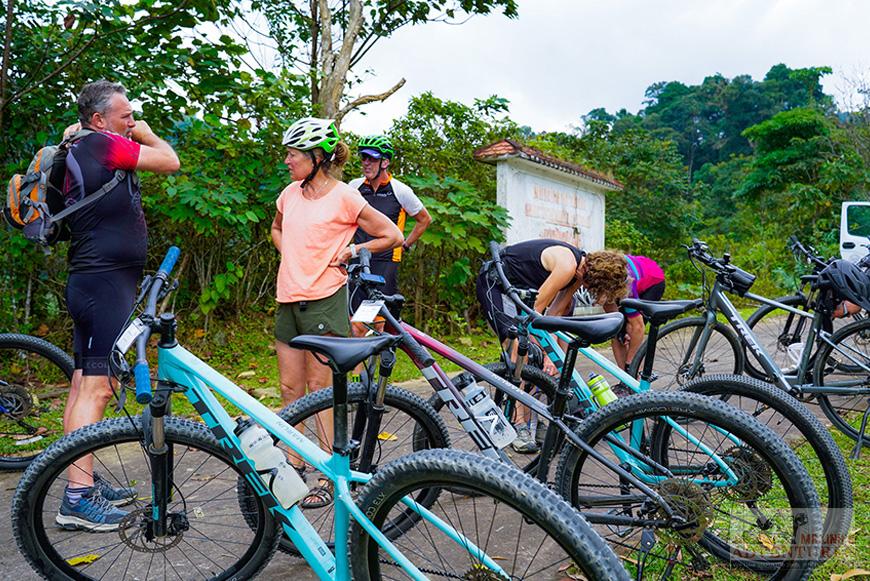 The bike is merely a key: what matters is what you unlock with it | Mr Linh's Adventures
The Mr Linh's Adventures angle: The bike as philosophy, not just tool
Cycle-tourism isn't about stacking kilometres like stamp-collecting: it's about listening to the road.
In Northern Vietnam, roads aren't neutral ribbons. They're full characters, with moods, whims, and occasionally a very damp sense of humour. At Mr Linh's Adventures, we don't sell kilometres. We offer rhythms.
It's subtle, but fundamental: we calibrate the itinerary to human cadence, not the speedometer. Yes, we offer mechanical bikes. And sometimes e-bikes when the ride deserves to be shared without martyring participants; but always with support. A local guide who knows the road like an old song; workshops where a man probably named Hùng turns a breakdown into an anecdote; homes where you truly sleep; shortcuts to avoid the 18-tonne lorry that thinks it's the centre of the universe; and smiles that open doors better than any GPS.
The support vehicle? Present. For luggage, assistance, a retreat from weather, and above all for delivering that ice-cold water bottle that brings you back to reason when heat decides to lead its own revolution. Itineraries calibrated to human step, not quantified performance.
The real "no-nonsense" truth? Here, performance weighs less than presence. The bike is merely a key: what matters is what you unlock with it: an involuntary conversation with a farmer, a pause before a forgotten temple, the slap of bare feet on earth, the taste of lime juice with salt. We respect communities, minimize impact, support the local economy, priorities safety; not as glossy CSR posturing, but because it's the only way to travel without leaving any trace but memories.
Shall we pedal together?
There is no absolute winner between mechanical and electric. Only two different ways to sit on a saddle and watch the world go by. The right choice is the one that fits your body, your pace, and what you want to experience between two bends. Vietnam isn't consumed. It's lived. And the right bike is the one that leaves your head free to look, speak, listen, and savour.
Want to try before you commit? Compare itineraries? Receive concrete advice based on your level, dates, and desires?
We're here. Not to sell you a product. To help you choose the right entry point into a country that doesn't let itself be easily tamed—but does let itself be met.
So, ready?
Discover our cycling routes (mechanical & e-bike), adjusted to human rhythm, guided by locals who know every bend, every coffee stop, every road worth taking. Because in Vietnam, pedalling isn't a performance. It's an invitation.