“Once a place becomes a destination, it ceases to be a discovery.” (Anonymous)
Sa Pa ahead of us! Yes, everyone knows Sapa.
Today is another thermal “shock”, in every sense of the word. We pass from hot climate to the high mountains. But above all, we pass from one H’mong to another H’mong people, and curiously it’s like two separate worlds. And still, the only concrete things that separate those two, are 140 kilometers, some Thai villages and towns, and the highest mountain pass in Vietnam - Tram Ton (1996m). Or is there something more to draw them apart?
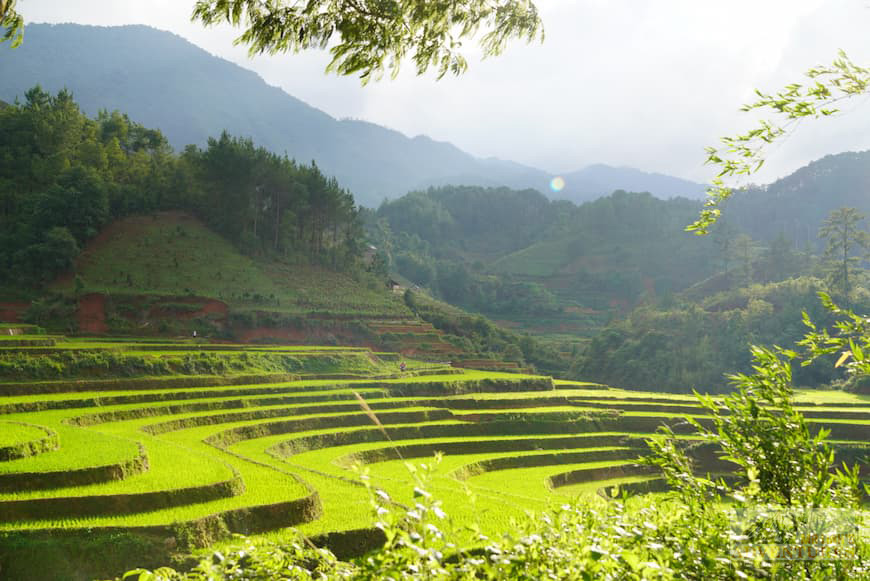 Where the the remote villages have no names... | Mr Linh's Adventures
To start the day with a rainy night is one of my favourites, especially when it’s in a remote part of H’mong community, up on the hill, with a view that has no price. Even more so thanks to the “lullaby” that the grandfather of our homestay family played to us last night on a very peculiar bamboo instrument - a well-kept secret of the H’mong people.
And then we take a 1.5 hours ride to another Thai village in Than Uyên valley - one of the four largest in Vietnam. Those strolls through the lives of local people have become our everyday pleasure - human being gets used to good things very fast! It’s like an energy boost for the whole day and maybe even for life.
The typical Thai houses on stilts, originally of wood and bamboo, nowadays often of cement and bricks. The different plants to be eaten, to be drunk or to be avoided, as David explains us: “Only 3 leaves of that one and you’re dead!” All those boys flying their kites with rare focus - an activity way more exciting than iPhone scrolling.
We peak into tens of gardens, curious of what they eat, how they cut the grass and where they sleep. And none, but none of the people is unfriendly with us. They don’t mind this curious bunch of curious Europeans looking into their backyards, even houses. People even come out to see us, to smile at us. So there we are, looking at each other, curious.
The children, shy, but sweetly smiling, follow us, as if they minded their own business. And we, taking Pictures of them. And they offering us some wild flowers. And we taking pictures with them. And then they… overcoming their shyness, ask to take pictures with us.
“This genuine hospitality is maybe connected to the poor population? When people get rich, they seem to lose it,” is one of the reflexions I hear today from my group of explorers.
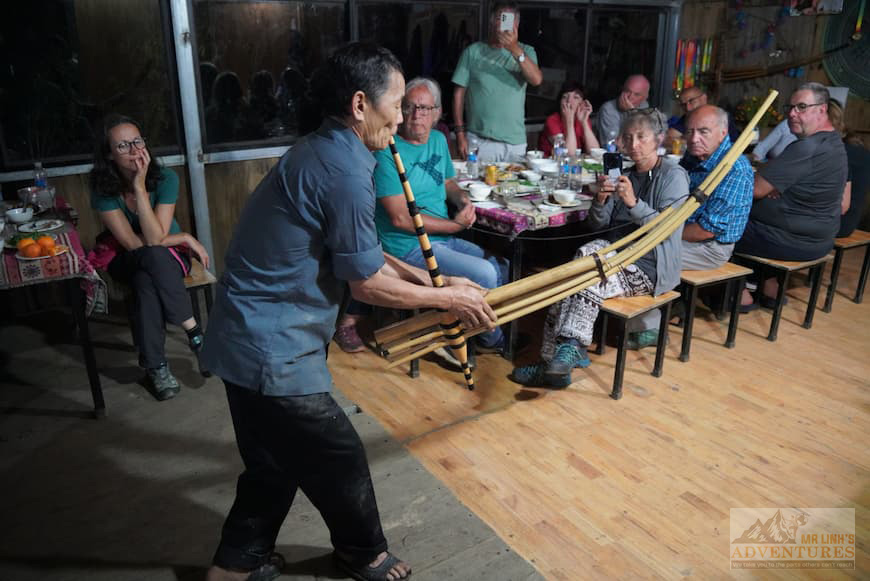 Playing Khen, the eternal sounds of the Northern Vietnam | Mr Linh's Adventures
Hmm, maybe. Maybe partly. I remember the hospitality of Mongols - impossible to pass their house without being invited in, even if you are 500m away. And still I’d like to believe that it’s not just that. All this time here, since the moment I got out of the airport, the Vietnamese people seem to have something that I’ve never met before - a genuine consideration of the Other, another human being,
“They are so kind, maybe because there are no many tourists here,” is another reflection of my group, referring to those fascinating sincere and welcoming faces, the smiles with no hidden agenda, just simplicity and kindness.
Hmm, again maybe. But still I want to believe that some of it is a special mix of their cultural way of being - it’s a country where people are not excessively rich, but they do not rob the others, there is a strong community support, respect for the other human being.
“I would feel very guilty and bad if I did something bad to someone else,” explains Hieu, our cameraman, “here in Vietnam, parents teach children that they have to be kind. It’s in our Buddhist values, even if you’re not a Buddhist.“
And then the shock. We pass the famous pass, we arrive to Sa Pa (it’s like Vietnamese Rimini or Chamonix) and we start our little hike through Lao Chai and Ta Van (Black H’mong villages), and there it is, the second world!
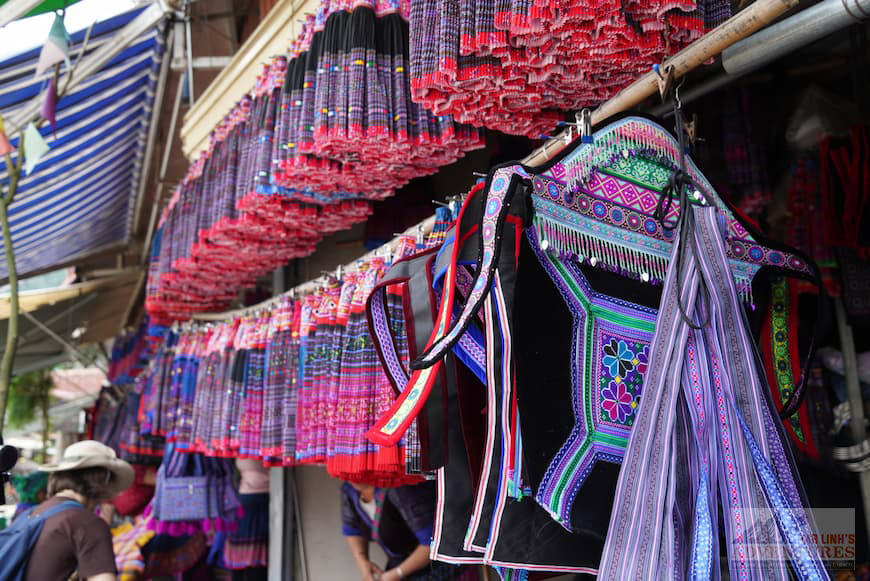 H'mong fabrics. Be careful of counterfeits! Mr Linh's Adventures
Again we are surrounded by local people (particularly women), again they are smiling and talking to us, again they are ready to invite us in for a moment. But from the way they fight to be the first at the bus door, we know - their questions of “What’s your name” and “Where are you from” have only one objective: to make us buy. The beautiful woman in one of the handicrafts shops is reproachful, almost upset, that we don’t buy anything, even after watching and photographing how they spin the thread and colour with indigo…
And the colours of the faces? Faded. Their rice puddles are just as beautiful, and still, …they lack the colours of genuine smiles. Or lets say, the colours are slightly defective. But then, this one woman who still follows us down to the village, even us not buying anything, I keep talking to her - why not!? - and bit by bit I find this sincere colour in her eyes as old as mine (44), but carrying the responsibility of 4 children and 10 grandchildren.
I’m grateful that Mr. Linh’s Adventures takes us to Sa Pa - it seems to be a MUST. I’m even more grateful it takes us to the remote villages which seem to have no names - the name would give me nothing anyhow. But then again, I’m actuallly grateful for Sa Pa, because this very touristic site makes us value even more the chance to see the “nameless” places with uncorrupt smiles.
Some why at the end of the day, the Little Prince comes to my mind… “What makes the desert beautiful is that somewhere it hides a well.” How to cherish this well and its desert without destroying their uniqueness and fragile equilibrium? How to have tourism, and still not to destroy by tourism?